
HOODS: THE NFX 15-211 STANDARD EXPLAINED
Published January 11, 2026
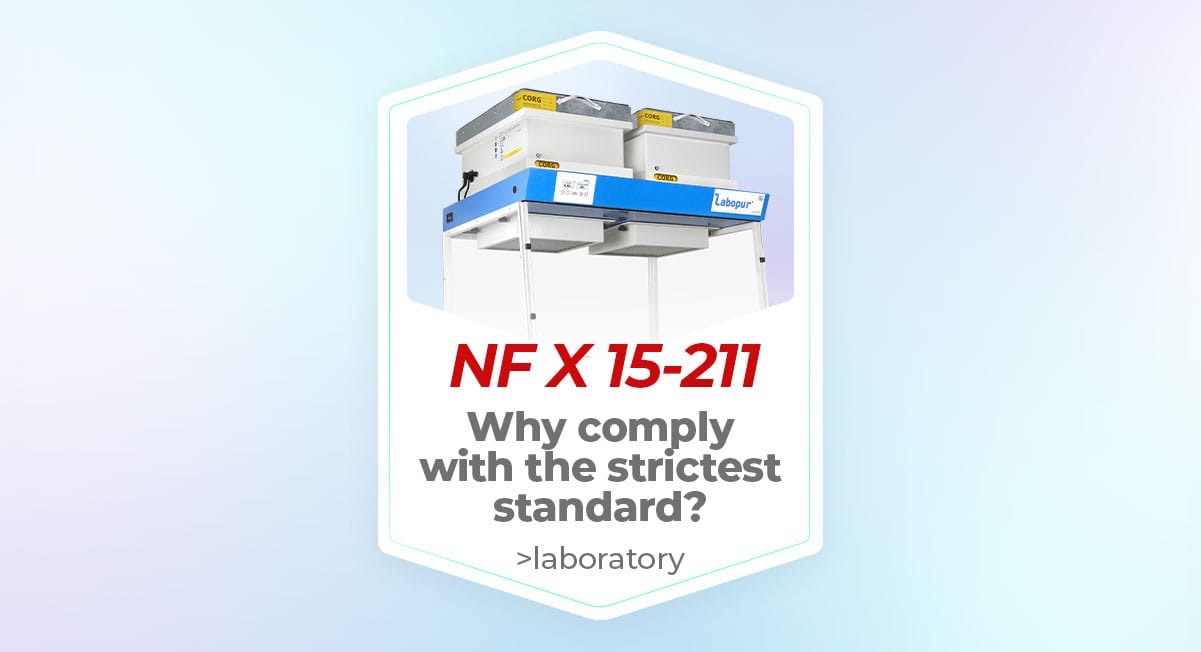
IN LABORATORIES AND AREAS WHERE CHEMICALS ARE HANDLED, AIR QUALITY AND OPERATOR SAFETY ARE MAJOR CONCERNS. THE FRENCH STANDARD NF X 15-211 PROVIDES A PRECISE FRAMEWORK FOR THE PERFORMANCE OF AIR RECIRCULATION FUMIGATION CHAMBERS, ALSO KNOWN AS FILTER HOODS. UNDERSTANDING THIS STANDARD IS ESSENTIAL FOR CHOOSING THE RIGHT EQUIPMENT FOR YOUR ACTIVITY AND ENSURING THE COMPLIANCE OF YOUR INSTALLATIONS. Today, the EN 17-242 standard exists and, of course, our equipment complies with it. However, the NF X 15-211 standard remains the standard that has ‘considered all risks’. It is the most stringent standard for air recirculation equipment. Keeping our equipment compliant with this standard is, in a way, a guarantee of superior safety. Unlike extraction hoods, which expel stale air to the outside, recirculating fume cupboards purify contaminated air using activated carbon filters before returning it to the laboratory. This technology offers considerable advantages: no energy loss associated with air renewal, simplified installation without connection to an extraction duct, and increased mobility of the equipment. However, the effectiveness of these devices depends entirely on the quality of the filtration. This is precisely what the NF X 15-211 standard guarantees. THE TWO PERFORMANCE CLASSES The NF X 15-211 standard is the most stringent regulation currently in force. It guarantees users enhanced safety, allowing them to concentrate on their work. Enclosures for toxic substances with filtered air recycling are classified according to two safety levels: Class 2: enclosure without safety reserve, most commonly used enclosure (only one activated carbon filter per filtration column). Class 1: enclosure with safety reserve (two activated carbon filters per filtration column). The NF X 15-211 standard also distinguishes between three classifications according to the type of filtration: Type V: for filtering chemical vapours (activated carbon filter). Type P: for particle filtration (the particle filter must be at least type H14). Type PV: for particle and vapour filtration (combined filtration). TECHNICAL REQUIREMENTS OF THE STANDARD Beyond classification, standard NF X 15-211 imposes rigorous design criteria. The incoming air flow must be uniform across the entire opening of the front panel to ensure optimal vapour capture. The air speed at the hand passage is strictly regulated to ensure effective containment without creating turbulence. Activated carbon filters are at the heart of the system. The standard specifies their absorption capacity, minimum service life and mandatory testing procedures. A continuous monitoring system must alert the user when the filter is saturated, a critical point at which the protection becomes insufficient. The fume cupboard must also incorporate suitable lighting, a chemical-resistant work surface and ergonomics that facilitate safe handling. Compliance with the NF X 15-211 standard is not limited to the purchase of certified equipment. A rigorous maintenance programme is essential. Filters must be replaced according to the manufacturer's recommendations and actual usage. An annual inspection by a qualified body ensures that performance is maintained. The mandatory maintenance log must record all interventions: filter replacements, air velocity measurements, leak tests, and the results of periodic inspections. This traceability is essential in the event of an audit or incident. The choice of an NF X 15-211 fume hood depends on several factors: the nature and quantity of the products handled, frequency of use, size of your laboratory, and installation constraints. Precise sizing by an expert allows you to optimise both safety and investment.